Investor brief · Confidential · 2026
Sources · Parseur/QuestionPro (2025), Gartner, BLS · conservative estimate
15.8M workers × $28,500/yr = $450B+
15.8M derived from Gartner's estimate of 100M US knowledge workers, narrowed to a conservative 15–16% subset in document-intensive regulated professions (finance, legal, insurance, healthcare). BLS data shows these three sectors alone employ over 13M.
$28,500/yr from a 2025 Parseur/QuestionPro survey of 500 US professionals reporting 9+ hours/week on manual data transfer.
Conservative. Excludes error correction (Gartner: $53–98 per error in financial services), compliance costs, and turnover from burnout (56% of affected employees report burnout, per Parseur).
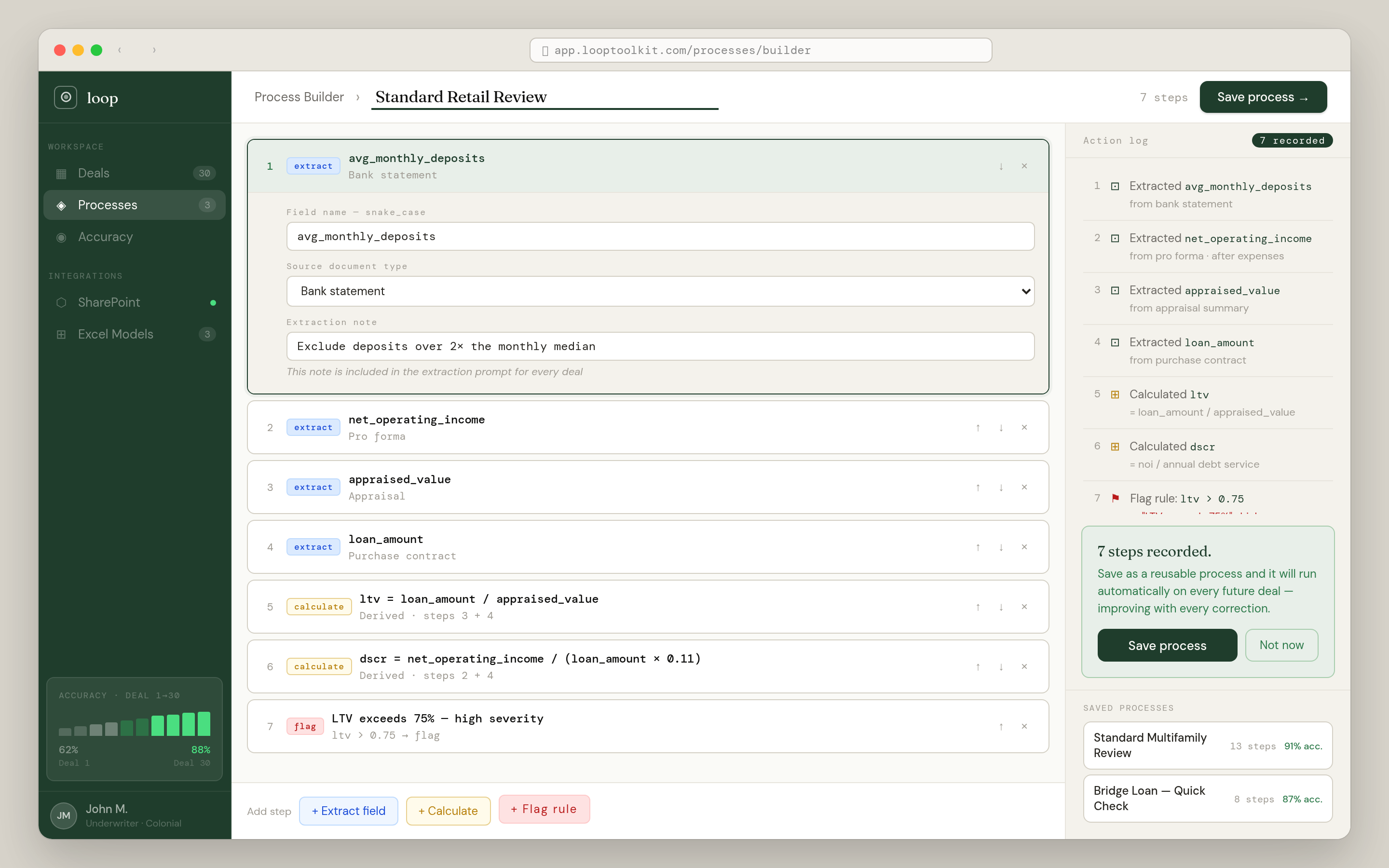
LOOP is an ai toolkit that helps professionals automate the pipeline from documents to decisions — and gets smarter every time your team uses it. Every action becomes a reusable workflow — without writing a line of code.
01The pipeline
Every action your team takes — pull, correct, flag — is teaching the system how the work actually gets done. Across every stage from documents to decisions, the expertise that lives in your senior reviewer's head becomes the system itself.
documents uploaded to team directories every year across lending, insurance, legal, and finance. Almost none of them talk to each other.
every single day spent by knowledge workers searching and gathering information — per employee, across every workflow. McKinsey Global Institute
In practice — five steps the team takes
Confidence isn't one thing. It's a composite of five independent signals that combine into a single score the reviewer sees. The model doesn't inherently know how confident it is — that signal gets engineered from the outside in.
LOOP connects any document to any decision model — and turns every correction into a self-improving competitive advantage.
02The core insight
LOOP is not an AI decision tool. It's a container that gets configured through use. Three or four saved processes in, the institutional knowledge is encoded inside LOOP, impossible to extract. The correction log is the moat. Compounding by design.
After the first deal — what the system asks
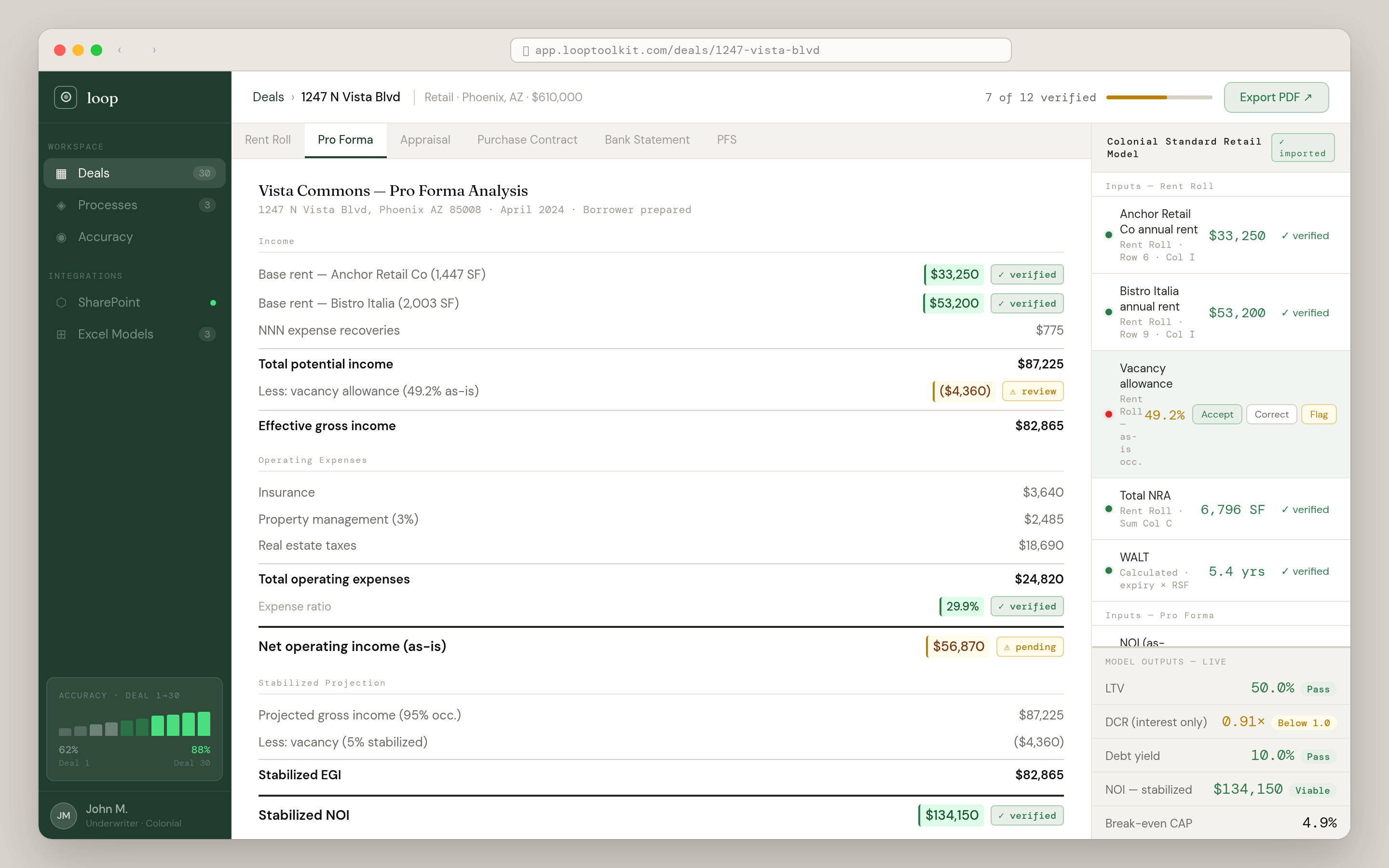
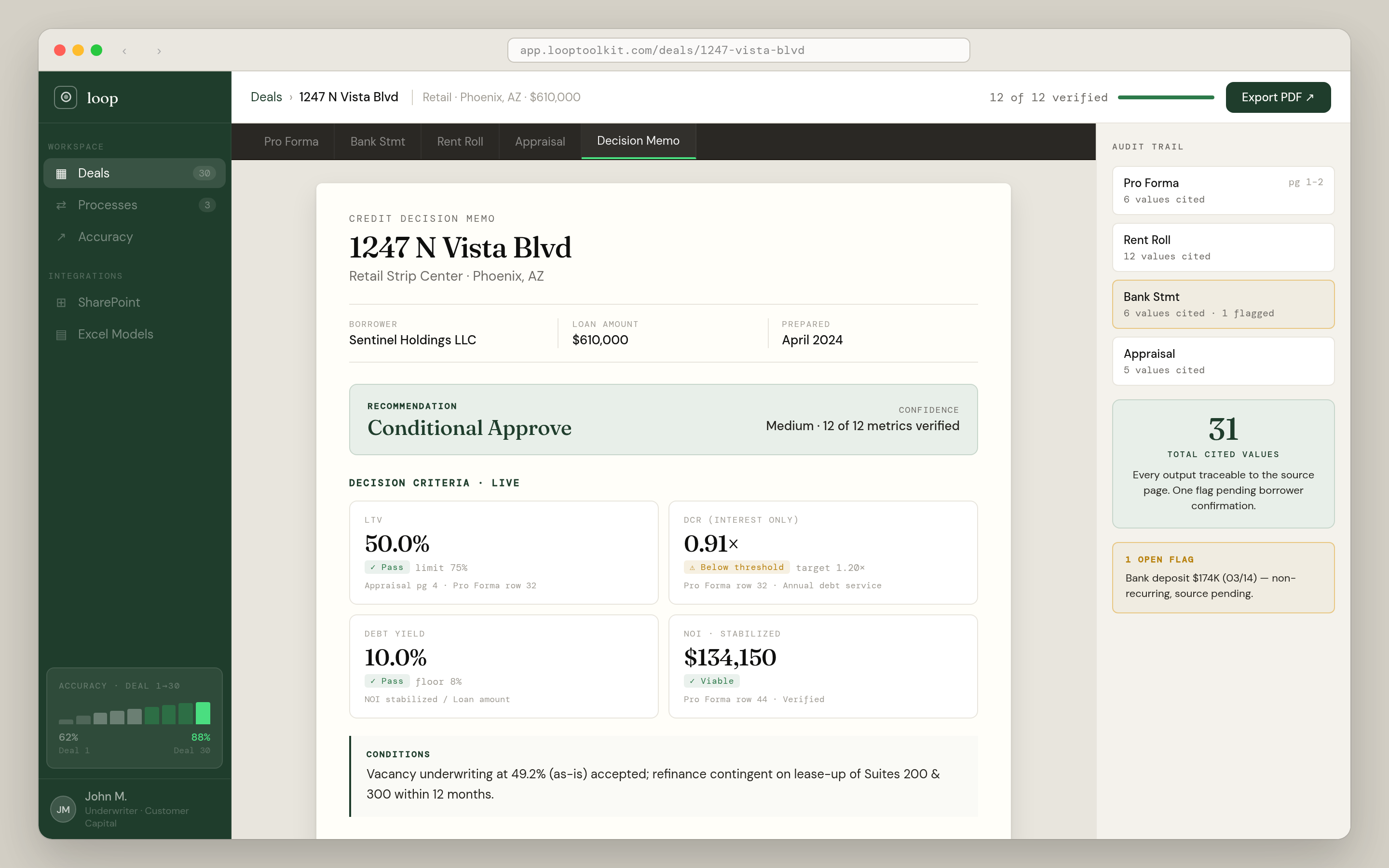
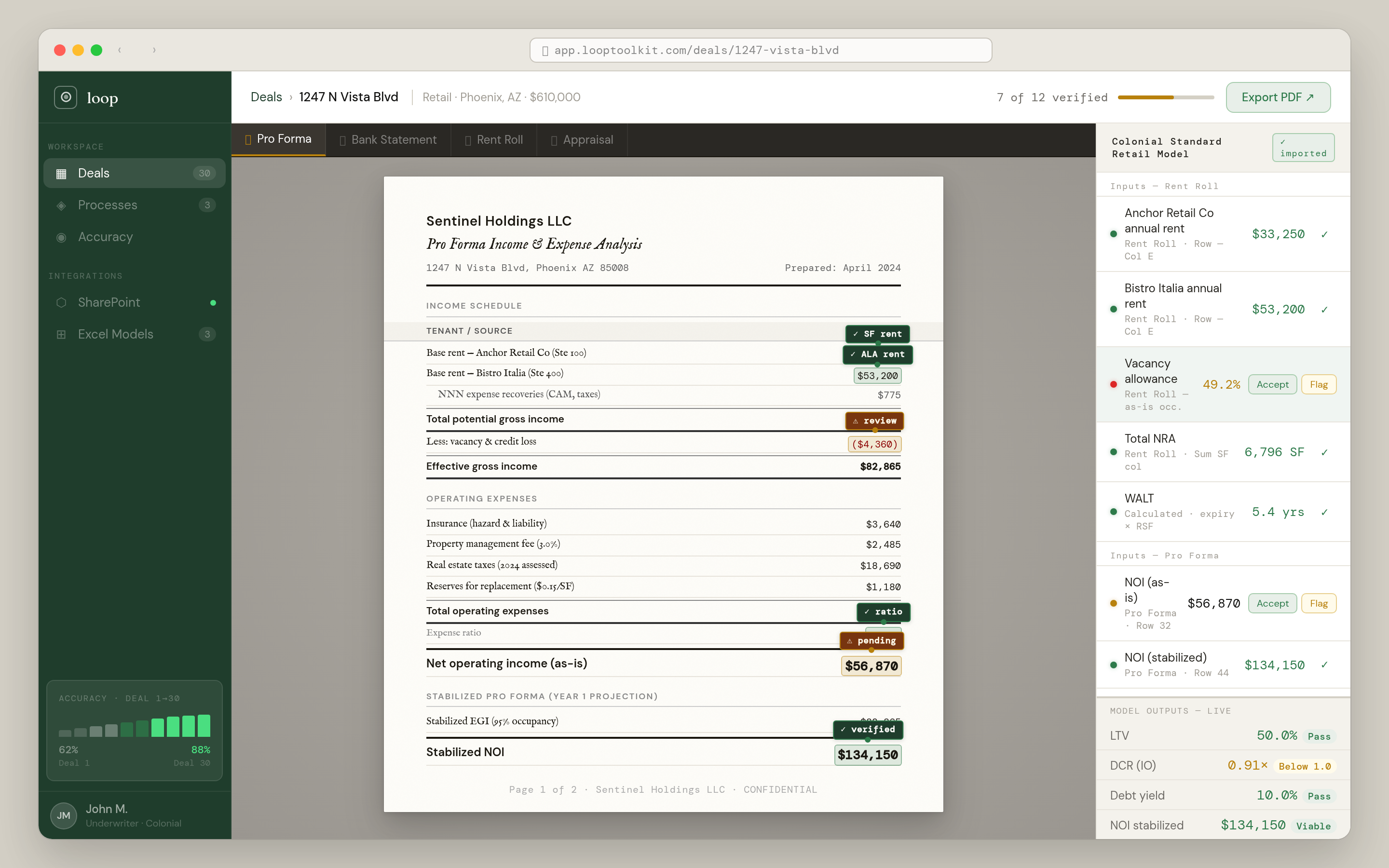
Extracted values surfaced with source citations. Accept, correct, or flag each field — inline, in seconds.
Accept, correct, flag, dismiss — each recorded with source document, value delta, timestamp.
Prompt logic updated immediately. Fine-tuning dataset accumulates for future model training.
Fewer corrections per decision. Switching cost grows with every decision processed.
“The correction log is institutional memory made portable — a mirror that gets sharper every time the team uses it. It exists only inside organizations that use LOOP, and grows more valuable with every decision processed.”
Every interaction is a signal
Five primitives. That's it.
Everything else — without writing code.
LOOP doesn't know what a good pro forma looks like. Doesn't know your DSCR threshold. Doesn't know your credit policy. The customer brings all of it. LOOP just builds the surface that captures it — which is exactly why big tech can't copy it.
The non-interference boundary — the structural reason this stays defensible.03Vertical strategy
Same pipeline across every regulated profession. The mismatch between decision volume and ease of adoption is the strategy: start with small markets reachable in weeks, earn the right to large markets that take years.
Plus six more verticals identified — Factoring & Invoice, Corporate Functions, Government & Regulatory, Commercial Banking Credit, Venture Debt, Family Office. See all 15 by volume or by ease of adoption.
Ranked by total addressable decision volume — largest to smallest. Color indicates priority tier.
| # | Vertical | Why it qualifies | TAM | Operators (US) | ARR (5% of operators) |
|---|---|---|---|---|---|
| 1 | Healthcare Prior Auth Year 3 | Billions of decisions/yr across all US payers. | $340B+ | ~7,000 | $7.6M350 subs |
| 2 | Commercial Banking Credit Future | Every US bank underwrites business loans. Massive scale. | $200B+ | ~4,500 | $4.9M225 subs |
| 3 | Corporate Functions Future | Procurement, AP, HR screening, ESG globally. | $180B+ | ~10,000 | $10.8M500 subs |
| 4 | Insurance Underwriting Year 2 | Commercial property, specialty lines, claims. | $120B+ | ~3,000 | $3.2M150 subs |
| 5 | Legal Due Diligence Year 2 | $350B US legal market — document review is majority of associate hours. | $80B+ | ~5,000 | $5.4M250 subs |
| 6 | Government & Regulatory Future | Permit review, grant administration, examination. | $60B+ | ~500 | $0.5M25 subs |
| 7 | Commercial Real Estate Year 2 | $20T asset class, every deal document-heavy. | $40B+ | ~15,000 | $16.2M750 subs |
| 8 | PE & Asset Management Year 3 | Deal screening, portfolio monitoring. High value per decision. | $30B+ | ~5,000 | $5.4M250 subs |
| 9 | SBA & Community Banking Near-term | Larger institutional footprint. More standardized but still manual. | $20B+ | ~4,000 | $4.3M200 subs |
| 10 | Equipment Finance Near-term | Large asset base, clear collateral documentation. | $15B+ | ~2,000 | $2.2M100 subs |
| 11 | Construction Near-term | Draw review, contractor prequalification, change orders. | $12B+ | ~1,500 | $1.6M75 subs |
| 12 | Private Lending Live | Highest pain per operator. Live deployment underway. | $8B+ | ~2,500 | $2.7M125 subs |
| 13 | Factoring & Invoice Year 2 | High volume, simpler document types. | $6B+ | ~1,000 | $1.1M50 subs |
| 14 | Venture Debt Future | Niche. Relationship-driven, limited scale. | $2B+ | ~50 | $54K2-3 subs |
| 15 | Family Office Future | Very few operators. High value per decision, minimal scale. | $1B+ | ~3,000 | $3.2M150 subs |
| Totalacross 15 verticals | $1.1T+ | ~64,000 | $69.2M~3,200 subs | ||
5% capture × Enterprise tier ($1,799/mo ≈ $21.6K/yr) applied to estimated US-based addressable enterprise operators. Operator counts are working approximations for sequencing — not forecasting precision.
Operator counts derive from public registries and industry trade associations. Per-vertical sources:
Ranked by how quickly each vertical moves from first conversation to active paying customer.
| # | Vertical | Why this order | Time to first $ |
|---|---|---|---|
| 1 | Private Lending | Live. Phoenix-based private lender deployment underway. Short sales cycle, acute pain, documents in SharePoint. | Weeks |
| 2 | Construction Lending | Adjacent to private lending. Same buyer profile, same doc infrastructure. | 1–2 mo |
| 3 | SBA & Community Banking | Underserved by software. Document types overlap heavily with live build. | 2–3 mo |
| 4 | Equipment Finance | Small shops, clear document set, similar buyer to private lending. | 2–4 mo |
| 5 | CRE Brokerage | CoStar/Crexi integrations already identified as the unlock. | 3–4 mo |
| 6 | Factoring & Invoice | Simpler documents, high volume, clear ROI. | 3–5 mo |
| 7 | PE & Asset Management | Sophisticated buyers. Longer sales cycles, more customization. | 4–6 mo |
| 8 | Commercial Insurance | Real pain, real budget. Buyer inside a larger institution. | 6–9 mo |
| 9 | Legal Due Diligence | High value. Conservative adopters — partner-level sale required. | 6–12 mo |
| 10 | Corporate Functions | Large enterprise buyers. Multi-stakeholder, long cycles. | 9–12 mo |
| 11 | Healthcare Prior Auth | Largest by volume. HIPAA, payer-specific rules, entrenched incumbents. | 12–18 mo |
| 12 | Family Office | Purely relationship-driven. Warm intro or nothing. | Unknown |
| 13 | Venture Debt | Too few operators. Too relationship-driven to scale. | Unknown |
| 14 | Government | Enormous volume. Procurement cycles measured in years. | 2–4 yr |
| 15 | Commercial Banking | Largest buyers. Longest cycles. Most entrenched systems. | 2–5 yr |
Why private lending first
The wild-west wedge: high pain, no incumbents, fragmented buyers, and document infrastructure that hasn't been touched by software. Sales cycles in weeks, not quarters. The flywheel can compound here in real-world conditions long before a larger vertical's procurement cycle even opens.
Roadmap
A second document intake layer is planned for external data sources — property records, county assessors, CoStar, Crexi, comparable sales platforms. Private lenders pull this data manually for every deal. Automating external fetch addresses their three largest stated pain points: doc-chasing, data entry, and data spreading.
04Market opportunity · Two frames
Knowledge worker time on document-to-decision workflows globally. ~25M target professionals at $80–200K loaded cost. Recapture 20% → $1T+ economic value → SaaS captures a fraction.
15 identified verticals × operators × realistic seat count × price point. IDP market projected $49.7B by 2035 at 32% CAGR (Spherical Insights, 2025).
US-based regulated professional services across LOOP's five near-term verticals. ~20,000 target firms × $500–$2,000/mo per firm.
Private lending, construction lending, and SBA in the US. ~25,000 target lenders × 10% penetration × $200/seat/mo × 2 seats avg, over 3 years.
05Competitive landscape
LOOP is not priced as a replacement for any single tool below. It replaces the combination — plus the hours of manual work that sit between them.
For scale: DocuSign automates one stage of this pipeline and is worth $9B. LOOP automates all four.
| Tool | What it does | Price | Gap LOOP closes |
|---|---|---|---|
| Ocrolus | Document processing / bank stmt analysis | $500–2,000/mo | Extraction only — no logic, no verification UI, no flywheel |
| Blooma | CRE deal analysis platform | $1,000–3,000/mo | Single vertical, no model import, no doc-to-cell mapping |
| nCino | Bank operating system / loan origination | $50,000+/yr | Enterprise sales, 12+ month implementation |
| Docusign | E-signature and document workflow | $25–40/user/mo | Signature only — no extraction, logic, or decision output |
| ABBYY Vantage | Intelligent document processing (IDP) | $3,000–15,000+/mo | Horizontal IDP — no domain flywheel, no model import |
| Microsoft Copilot | AI assistant embedded in Office | $30/user/mo | Horizontal — no vertical depth, no domain decision logic |
| LOOP | Docs → Data → Logic → Decisions pipeline | $299–1,799/mo | Full pipeline — extraction, model import, verification UI, correction flywheel |
06Pricing
A mid-level team member runs $48/hr fully loaded. LOOP recaptures 3.3 hours per decision. At ten decisions a month that is $1,584 of monthly labor value recaptured. The Starter tier costs $299. Every tier delivers a minimum 4× ROI.
“Businesses hire 5 people. Only 4 show up to work.”
American knowledge workers spend 1.8 hours every day searching and gathering information — the equivalent of one full work-week per month, lost to manual document handling.
— McKinsey Global InstituteBeyond the time saved, five things become possible that simply weren't before.
Run the math
Move the sliders to model your shop. The math mirrors the live deployment: 4.0 hrs → 0.7 hrs per decision, 3.3 hrs recaptured.
07Revenue scenarios
All three share the same tiers and addressable market. What differs is adoption speed, churn rate, and tier mix. The single variable with the largest impact is monthly churn — at 1% the correction flywheel has done its job; customers cannot leave without abandoning institutional knowledge encoded over dozens of decisions.
All ARR figures computed live from new customers, tier mix, churn rate, and expansion. Adjust the toggle above to see how the simulation responds.
08Traction
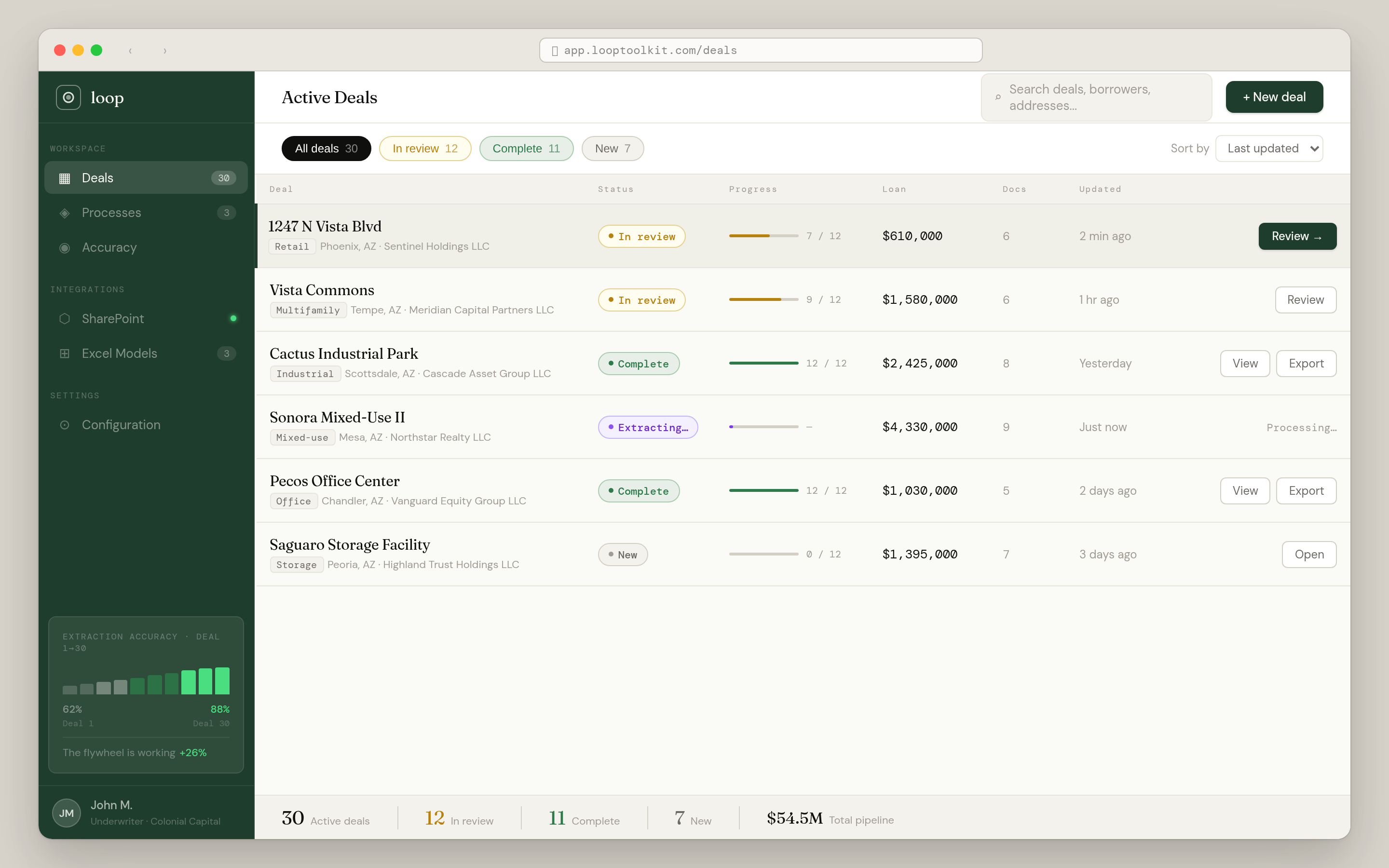
Live deployment with a private lending operation in Phoenix, AZ — 30 active deals in pipeline, design partner paying and engaged.
Correction logging instrumented — every accept, correct, flag, dismiss captured with source document, value delta, and timestamp. The flywheel is running.
SharePoint integration complete — real deal folders ingested and classified, Sites.Read.All permission scope authenticated.
Excel underwriting model import — existing lender models connected without rebuilding, formula preservation, cell-to-doc mapping.
Extraction tested against 30 real deals — retail, multifamily, mixed-use, non-standardized borrower documents across all types.
Full-stack application live at colonial-os.com — React + FastAPI + Postgres on Hetzner, white-labeled for the design partner.
Interactive wireframe at loop-mocks.netlify.app — clickable surface showing the document → data → logic → decision flow.
09Why now
Frontier AI models crossed the extraction quality threshold in 2024 — reliable enough to be useful on day one, correctable enough to compound continuously. The window to build a proprietary self-improving correction dataset before a well-funded incumbent enters this space is open. The pain point is too large for it to stay open for long.
Frontier models can now extract structured data from non-standardized documents with enough accuracy to be useful immediately. Two years ago this wasn't true.
nCino serves banks. Ocrolus serves mortgage. No one is purpose-building for the private lending workflow with a compounding data moat. The category is uncontested.
10Funding strategy
Plan: bootstrap through the first five external customers. One paying customer proves the product works, not that strangers will buy it. Every month spent building the correction dataset deepens the flywheel and strengthens the negotiating position for any future raise. The trigger for the first round is a single chart: extraction accuracy on decision one versus decision fifty.
The chart that unlocks everything
Extraction accuracy on decision one versus extraction accuracy on decision fifty. If that number moves materially, the correction flywheel is empirically real. That single chart — not the memo, not the financial model — converts a curious investor into a convinced one. Building the instrumentation to capture it starts on day one.
Next steps
For prospective customers
If your team underwrites commercial real estate, construction, or SBA loans and spends significant time on document gathering and data entry, LOOP was built for you. Design partners receive preferred pricing, direct influence over the roadmap, and early access to the process library as it develops.
For investors
The decision to raise will follow proof of the feedback flywheel in a live multi-lender environment. Conversations with aligned investors are welcome now — long before any term sheet. The pre-seed trigger is a single chart: extraction accuracy on decision one versus decision fifty.
LOOP is the infrastructure layer that converts document-heavy workflows into automated decision pipelines that compound over time.